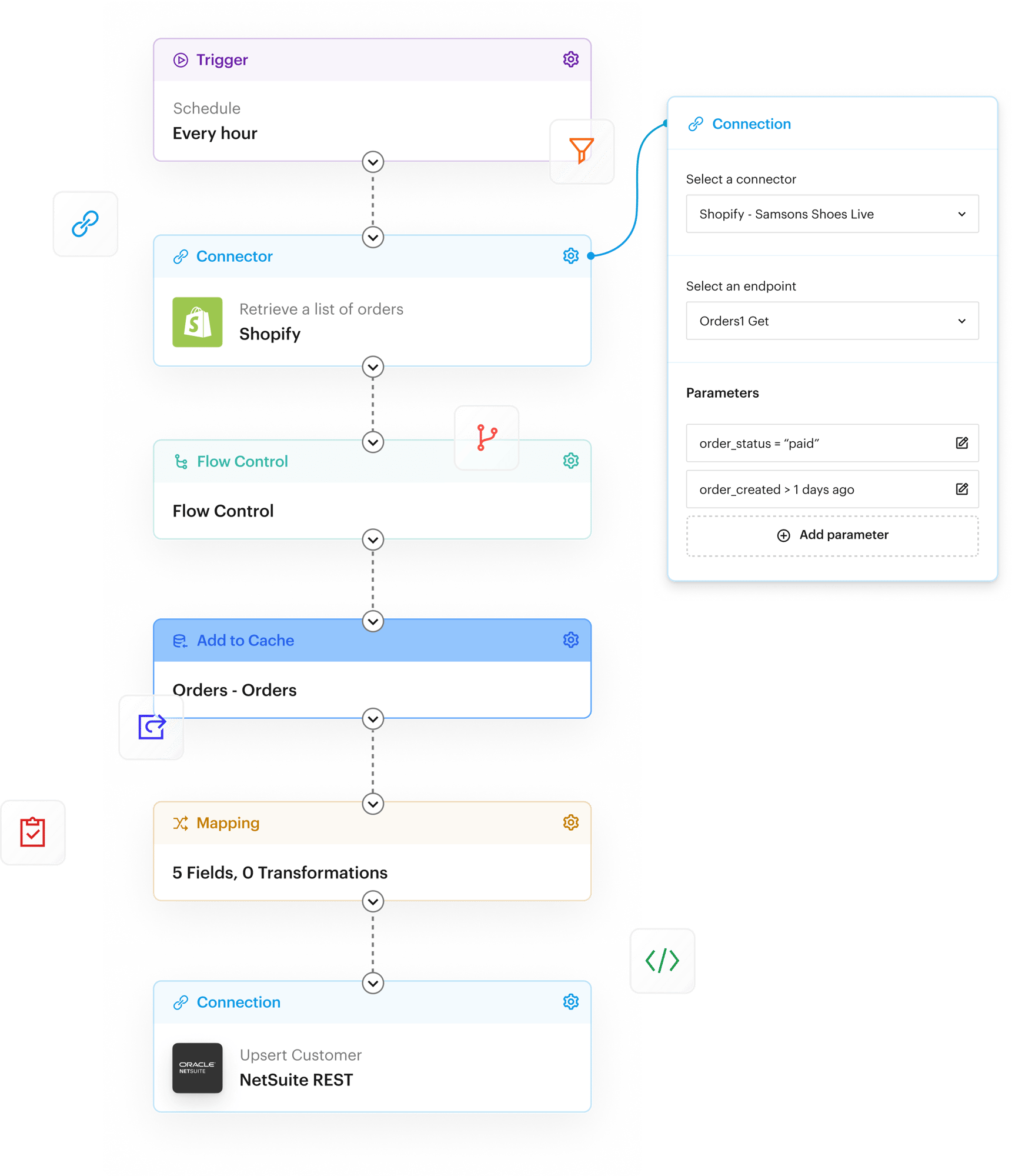
Enterprise-wide integration is powerful. Retail execution demands precision.
Boomi is a well-established enterprise integration platform designed to connect complex IT landscapes across industries.
Patchworks is purpose-built for retail environments — where ERP, ecommerce, marketplaces, WMS and finance systems must operate reliably during peak volatility and sustained growth.
If you're evaluating integration strategy, the question isn’t simply about scale.
It’s about whether the architecture is engineered for retail operating patterns — not generic enterprise connectivity.
Talk to an integration specialist today!
The challenge enterprise retailers face
Modern retail stacks are increasingly complex.
They often include:
• ERP as the operational backbone • Multiple commerce platforms and regions • Marketplaces and DTC channels • PIM and WMS systems • Finance integrations • Peak trading volatility
Enterprise integration platforms can connect all of this. But connection alone is not the same as orchestration.
Retail environments demand infrastructure designed specifically around commerce-critical flows.
Where Boomi fits
Boomi is strong for: ✓ Broad enterprise system connectivity ✓ Multi-department IT integration ✓ API management and lifecycle governance ✓ Large-scale digital transformation initiatives
Boomi is designed to solve horizontal, enterprise-wide integration challenges across departments and industries. Retail operating models introduce performance patterns that generic enterprise platforms aren’t specifically structured around.
Enterprise integration vs retail orchestration
Boomi supports enterprise-wide integration. Patchworks focuses on retail infrastructure.
In retail environments, the integration layer must:
Maintain ERP stability as volumes grow
Propagate pricing and inventory changes reliably across channels
Safeguard order flow during demand spikes
Enable safe replatforming
Reduce operational risk during peak periods
Scale without introducing architectural overhead
The goal isn’t simply to connect systems. It’s to sustain commerce operations reliably at scale.
Why Patchworks is built for modern retail
Patchworks is structured specifically around retail integration depth and performance.
Retail-first architecture
Built around commerce platforms (Shopify, BigCommerce, Adobe Commerce and others), ERP, WMS, PIM and finance systems — with retail data orchestration at the core.
Designed for peak resilience
Brands such as Castore modernised system communication to reduce operational strain during high-pressure trading periods.
Proven in complex transformation
Belstaff reshaped intricate system interactions to support digital expansion without layering brittle, custom integrations.
Supports replatforming safely
Whether moving to Shopify, BigCommerce, Adobe Commerce or consolidating ERP systems, Patchworks is designed to reduce integration risk during major change initiatives.
Enterprise-ready governance
ISO/IEC 27001:2022 certification supports enterprise procurement and compliance requirements.
MACH-aligned composability
As a member of the MACH Alliance, Patchworks supports composable architecture principles — grounded in retail operational reality.
Commercial alignment
A collaborative, growth-aligned commercial structure avoids unnecessary platform sprawl and excessive implementation overhead.
Side-by-side comparison
Evaluation area
Boomi
Patchworks
Core positioning
Enterprise integration platform
Retail-first integration infrastructure
Architectural scope
Horizontal, multi-industry IT integration
Vertically specialised retail orchestration
Implementation model
Enterprise implementation programmes
Retail transformation-aligned implementation
Peak trading focus
Indirect
Central to architecture design
Replatforming support
Enterprise transformation enablement
Retail transformation-led orchestration
Long-term retail scalability
General flexibility
Designed around evolving retail stacks
Architecture philosophy
Generalised automation
Composable, MACH-aligned retail orchestration
Security & governance
Enterprise-grade
ISO/IEC 27001:2022 certified
Commercial model
Platform licensing
Collaborative, growth-aligned structure
What changes when the architecture fits?
When integration is purpose-built for retail:
✔ ERP remains stable under scale ✔ Peak trading becomes engineered, not reactive ✔ Operational risk reduces ✔ Replatforming initiatives feel controlled ✔ Reduced integration-led technical debt ✔ Engineering teams avoid integration sprawl ✔ Integration becomes infrastructure — not an IT expansion project
Does Patchworks support enterprise-scale environments?
Yes. Patchworks is used by enterprise retailers operating complex, multi-system environments and high transaction volumes, while maintaining retail-focused architecture.
Can Patchworks handle custom logic and complex data flows?
Yes. Complex ERP orchestration, pricing logic and high-volume flows are core use cases.
How does pricing compare?
Boomi typically follows enterprise platform licensing models.
Patchworks operates a collaborative, growth-aligned commercial structure designed specifically for retail environments.
Will this limit flexibility if we expand?
No. Patchworks is designed to evolve alongside your stack — whether you add marketplaces, expand internationally or change commerce platforms.
Is Boomi too complex for retail use cases?
Boomi is a powerful enterprise integration platform.
However, retailers focused primarily on commerce-ERP orchestration may find that specialised retail integration platforms provide architectural alignment without broader IT overhead.
Can Patchworks scale globally?
Yes. Patchworks supports multi-region, multi-channel retail environments while maintaining structured governance and orchestration depth.
When integration becomes infrastructure, misalignment becomes expensive.
If you’re:
• Scaling into new markets • Consolidating complex ERP environments • Planning a replatform • Questioning whether enterprise-wide tooling is introducing unnecessary complexity
The integration layer should reduce risk — not expand it.
Let’s pressure-test your retail architecture against real operational demands.