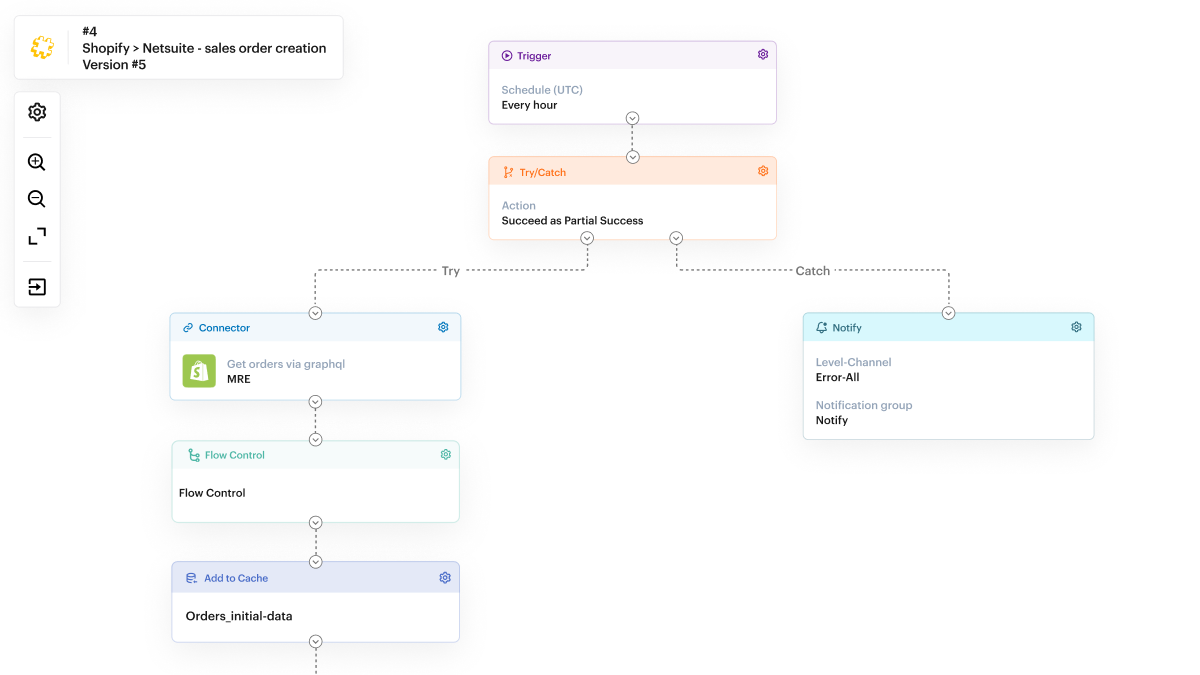
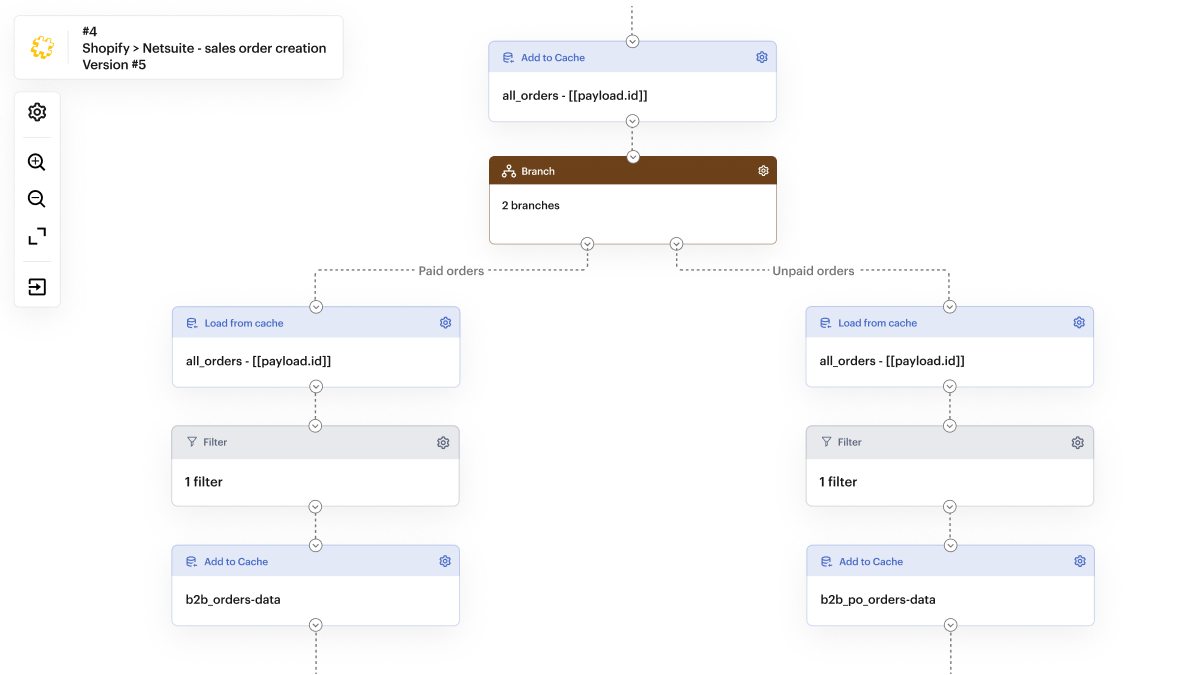
Shopify–NetSuite ERP integration built for modern eCommerce at scale
Launch faster with a pre-built, fully customisable Shopify–NetSuite ERP accelerator — designed to support complex inventory, pricing, and order workflows across D2C, B2B, and hybrid commerce models.
Pre-built Shopify–NetSuite accelerator
Fully customisable on a retail-first iPaaS
Built to scale with high order volumes and operational complexity
Talk to our team →
Who the Shopify–NetSuite accelerator is designed for
If your Shopify–NetSuite integration needs to evolve, this accelerator was built for you.
Why Shopify–NetSuite integrations break as commerce complexity grows
Connecting Shopify to NetSuite isn’t difficult. Keeping that integration reliable as order volumes, channels, and operational requirements change is.
Fixed data models that don’t reflect real pricing or marketplace structures
Inventory and fulfilment logic that breaks under scale
Limited visibility into errors and performance
High cost and risk when changes are required
The issue isn’t Shopify or NetSuite — it’s the integration layer between them.
A faster, safer way to integrate Shopify and NetSuite
Patchworks’ Shopify–NetSuite accelerator provides a production-ready integration foundation — built on a retail-first iPaaS — so teams can launch quickly without sacrificing flexibility.
Pre-built integration flows → reduce time to value
Extensible data mappings → support real-world commerce logic
Workflow orchestration → manage orders, inventory, and finance at scale
Full visibility and control → monitor, troubleshoot, and optimise integrations
What’s included in the Shopify–NetSuite accelerator
✔️ Orders from Shopify to NetSuite
✔️ Inventory updates from NetSuite to Shopify
✔️ Customer and company data synchronisation
✔️ Refunds, fulfilment, and status updates
✔️ Financial and operational data alignment
Additional flows and logic can be added or modified as requirements evolve
Why teams choose a Patchworks accelerator over basic connectors
For teams planning to scale, flexibility and control quickly outweigh simplicity.
Basic connectors
Patchworks Accelerators
Fixed logic
Fully customisable
Limited visibility
Full monitoring & control
Hard to scale
Designed for high volume and peak trading growth
Rebuilds required
Evolves without rewrites
Built in close collaboration with Shopify
While these accelerators were designed to support Shopify’s growing B2B capabilities, they’re just as effective for high-growth D2C and omnichannel brands — where reliability, scale, and flexibility matter just as much.
Built in close collaboration with Shopify
The only Shopify Certified Tech Partner iPaaS
Featured in Shopify Winter Editions ’26
Aligned with Shopify’s enterprise-class integration strategy
Is the Shopify–NetSuite accelerator right for you?
If any of these sound familiar, it’s worth a conversation with our friendly experts.
Do you need Shopify and NetSuite to support complex workflows?
Are pricing, inventory, or fulfilment requirements evolving?
Do you want visibility and control over integration logic?
Are rebuilds and workarounds slowing your team down?
Shopify–NetSuite integration FAQs
Is this approved by Shopify?
Yes.
The Shopify–NetSuite accelerator was built in close collaboration with Shopify and was approved and featured in Shopify Winter Editions ’26, following a thorough review process.
Is this a pre-built connector or a custom integration?
It’s a pre-built integration accelerator running on Patchworks’ retail-first iPaaS.You can use it out of the box to get up and running quickly, or treat it as a template foundation and extend, customise, or optimise it as your requirements evolve.
How is this different from basic Shopify–NetSuite connectors?
Basic connectors are typically designed for common, early-stage use cases and fixed data models. The Patchworks accelerator is built to: ✔️ Support complex pricing and marketplace structures ✔️ Orchestrate workflows, not just sync data ✔️ Provide visibility, monitoring, and control ✔️ Scale without requiring rebuilds as requirements change It’s designed for teams planning to grow, not just connect systems.
Can the integration be customised to match our workflows?
Yes. Fully.
All data mappings, logic, and workflows can be adapted to match how your business actually operates — including pricing rules, fulfilment processes, and reporting requirements. Customisation is a core feature, not an add-on.
What Shopify features does this support?
The accelerator was designed to work alongside Shopify’s B2B features, but it’s just as important to fast-growing D2C omnichannel brands with company structures, marketplace sprawl, and ERP-led workflows. It’s aligned with Shopify’s enterprise-class integration strategy and built to support real-world enterprise commerce use cases.
How long does it take to implement?
Because the accelerator is pre-built, implementation is significantly faster than starting from scratch.
Exact timelines depend on: ✔️ Your data models ✔️ Workflow complexity ✔️ Customisation requirements
During an initial conversation, we’ll help you understand what’s realistic for your setup.
Is this suitable for hybrid B2B and D2C businesses?
Yes.
Many Shopify merchants run both D2C and B2B from the same platform. The accelerator is flexible enough to support hybrid models while keeping ERP data consistent and reliable.
Do we need in-house developers to use this?
Not necessarily.
Patchworks is designed to be: ✔️ Developer-friendly ✔️ Agency-friendly ✔️ Supported by our integration experts
Some teams manage integrations internally, while others work with agency partners — both approaches are supported.
How does Patchworks handle errors and monitoring?
Patchworks provides visibility into: ✔️ Integration performance ✔️ Errors and failures ✔️ Data flow health across systems
This allows teams to identify issues quickly and resolve them without guesswork or brittle fixes.
See how Shopify–NetSuite integration should work
Walk through your current setup, future requirements, and how the accelerator can be adapted to fit — with practical guidance from our integration experts